Waymo’s Long Game: Safety, World Models, and Exponential Scaling
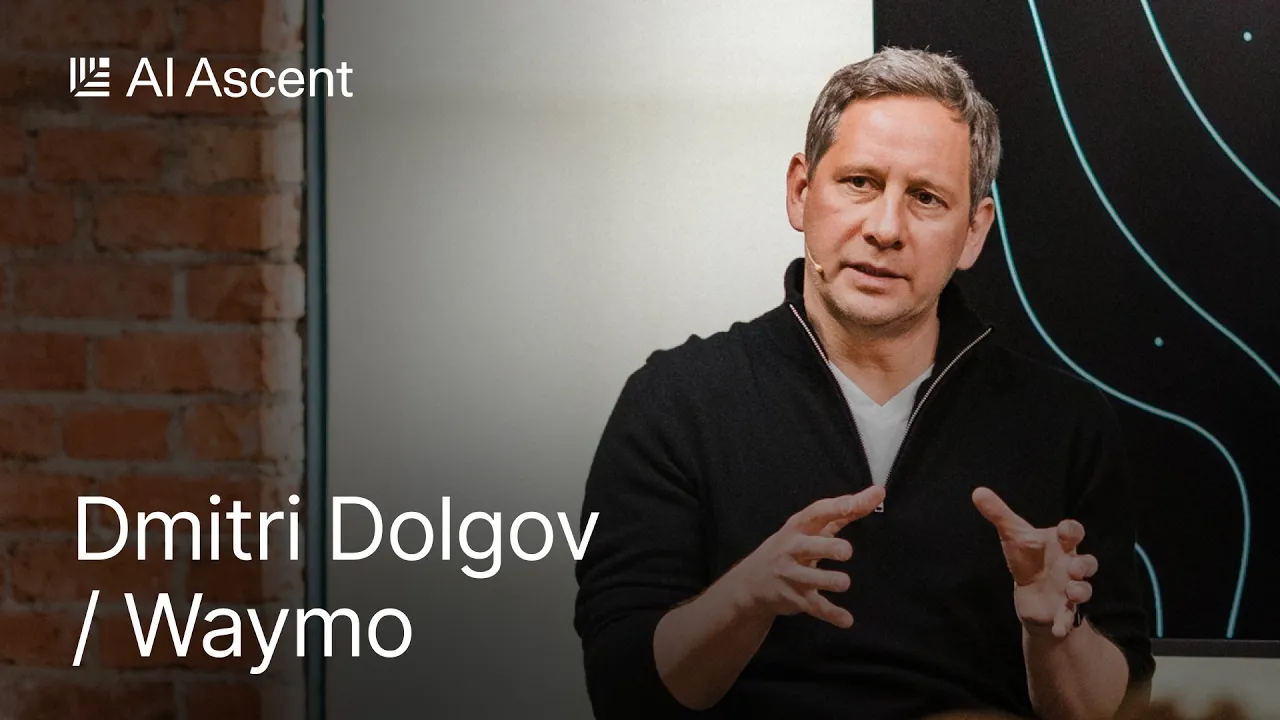
Published 2026-05-01 - Runtime about 27 min - Watch on YouTube
Waymo’s edge is not a single breakthrough; it is a long, safety-first accumulation of data, hardware, and deployment discipline. Dmitri Dolgov frames autonomy as a product problem that only becomes real when a driver can scale city by city, survive hype cycles, and outperform humans in the messy edge cases of traffic.
What Matters
- Dolgov says autonomy was a “light switch moment” during the 2005 DARPA Grand Challenge and Urban Challenge: the mission, technology, and real-world product all lined up.
- Early Google self-driving goals were concrete: 100,000 autonomous miles and 10 Bay Area routes of 100 miles each, completed in about 18 months.
- Waymo’s foundation model is a multimodal world action language model powering three pillars: the driver, the simulator, and the critic.
- He rejects pure end-to-end purity: Waymo combines learned representations with structured intermediate representations for runtime validation, closed-loop evaluation, RL rewards, and scale deployment.
- Sixth-generation Waymo Driver prioritizes performance, simplification, cost reduction, and high-volume manufacturing; the latest vehicle platform is the Ioniq 5.
- Scaling has turned exponential: Waymo says it passed 20 million fully autonomous rides, with 10 million in the last seven months, and launched four cities in one day.
- Safety stays the non-negotiable baseline: over 170 million fully autonomous miles, Waymo claims more than 13x fewer serious-injury collisions than human drivers in its operating cities.
- A vivid example: lidar reportedly caught a pedestrian’s feet under a bus by sparse returns, triggering a defensive response before the person emerged.