Sequoia’s 2026 AI Thesis: Agents, Services, and Computation
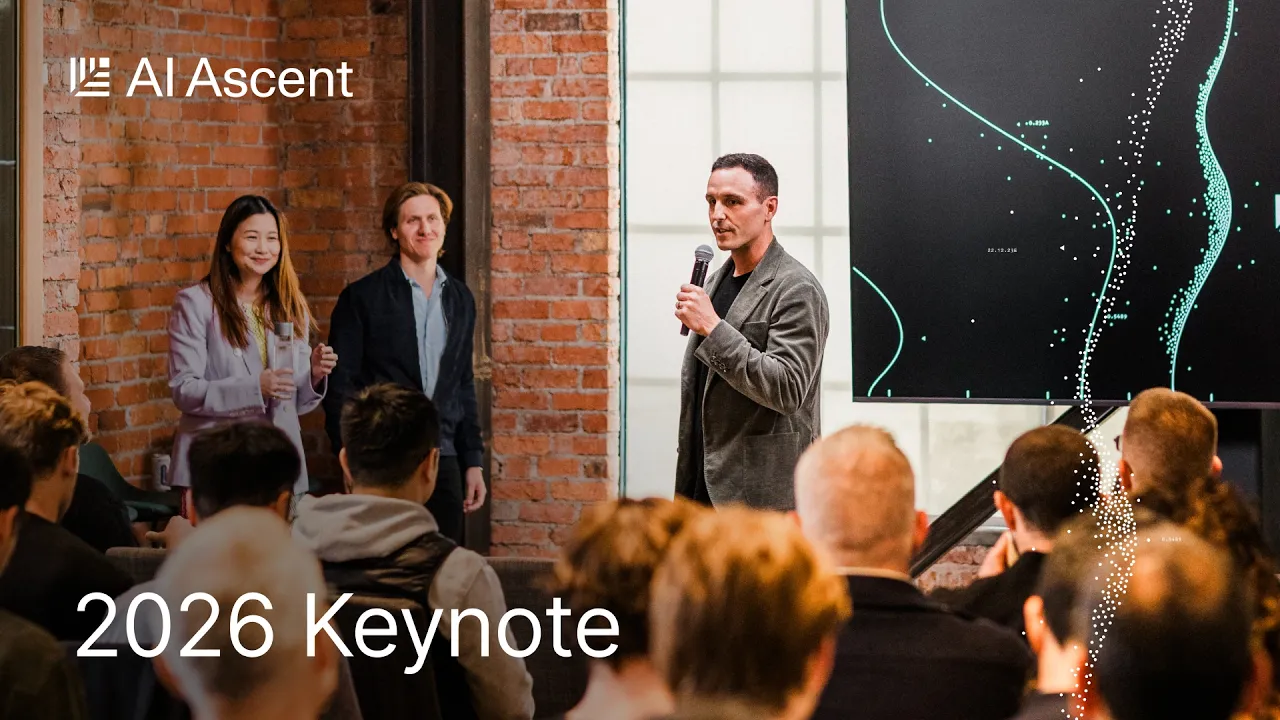
Published 2026-04-30 - Runtime about 32 min - Watch on YouTube
AI is being framed here as a computation revolution, not a communication revolution: agents can now persist through failure, use tools, and finish work. That shifts the prize from better software to software-plus-services, and it compresses what teams can build, ship, and monetize.
What Matters
- Pat Grady’s central claim: AI is the first wave that is both software and services, with a stated opportunity around $10 trillion and legal services alone a $400 billion U.S. market.
- The new benchmark is long-horizon agents: from ChatGPT’s pre-training moment to o1’s inference-time reasoning to Claude Code and the 47-series showing agents that recover from failure and keep going.
- Sequoia’s build advice is MAD: modes, affordance, diffusion. Wrap around customers, not just model capabilities, because customer needs move slower than foundation-model features.
- Sonia Huang says 2026 is the year of agents: models now sustain complex tasks for hours instead of tens of minutes, making async agents and sub-agent systems the likely volume winner.
- Her claim is blunt on economics: hiring agents is easier than hiring employees because tokens scale like compute, while humans are expensive, hard to scale, and hard to keep happy.
- The strongest product shift is “services is the new software”: agents for medicine, law, finance, and consumer chores can inspect genomes, negotiate contracts, manage inboxes, and file taxes.
- Konstantine Buhler extends the analogy to cognition: if machines already do 99 plus% of physical work, neural networks may push machine-made cognition toward 99.9% too.
