The Physical Turing Test: Jim Fan on Nvidia's Roadmap for Embodied AI
Watch on YouTube ↗ Summary based on the YouTube transcript and episode description.
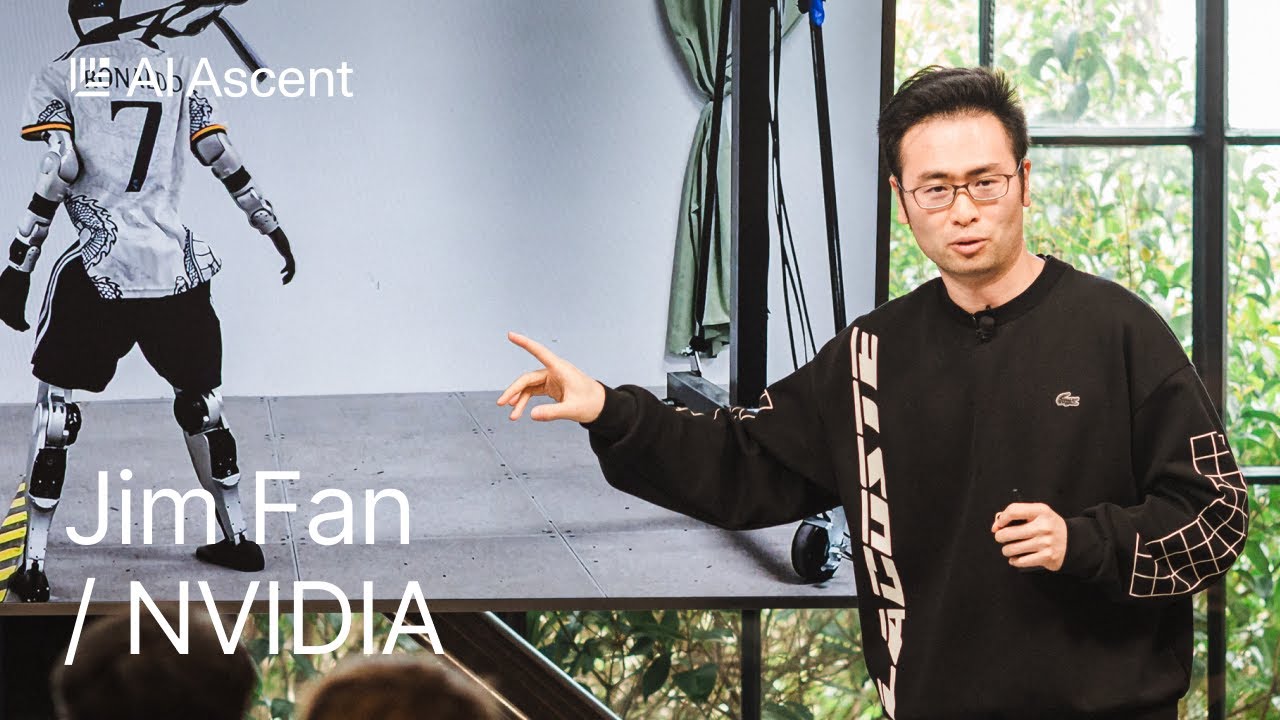
Jim Fan (Nvidia) argues simulation at scale — not more real-world data — is the only path to passing the Physical Turing Test for robotics.
- Real robot training data cannot be scraped from the internet; teleoperation caps at under 24 hours per robot per day and does not scale.
- Nvidia runs 10,000 parallel physics simulations on a single GPU with domain randomization (gravity, friction, weight) to generate training data.
- A 1.5-million-parameter network — not billion-scale — is sufficient to control full humanoid whole-body motion zero-shot from simulation.
- Nvidia’s Groot N1 visual-language-action model is fully open-source and handles grasping, industrial pick-and-place, and multi-robot coordination.
- ‘Digital cousins’ (generative hybrid physics) and ‘digital nomads’ (video diffusion world models) extend simulation diversity beyond handcrafted digital twins.
- Video diffusion models fine-tuned on robot lab data can simulate counterfactual futures from language prompts, including interactions never demonstrated in real life.
- Fan frames the end state as a ‘Physical API’ where software issues instructions that move atoms, enabling a skill economy analogous to the app store.
2025-05-07 · Watch on YouTube