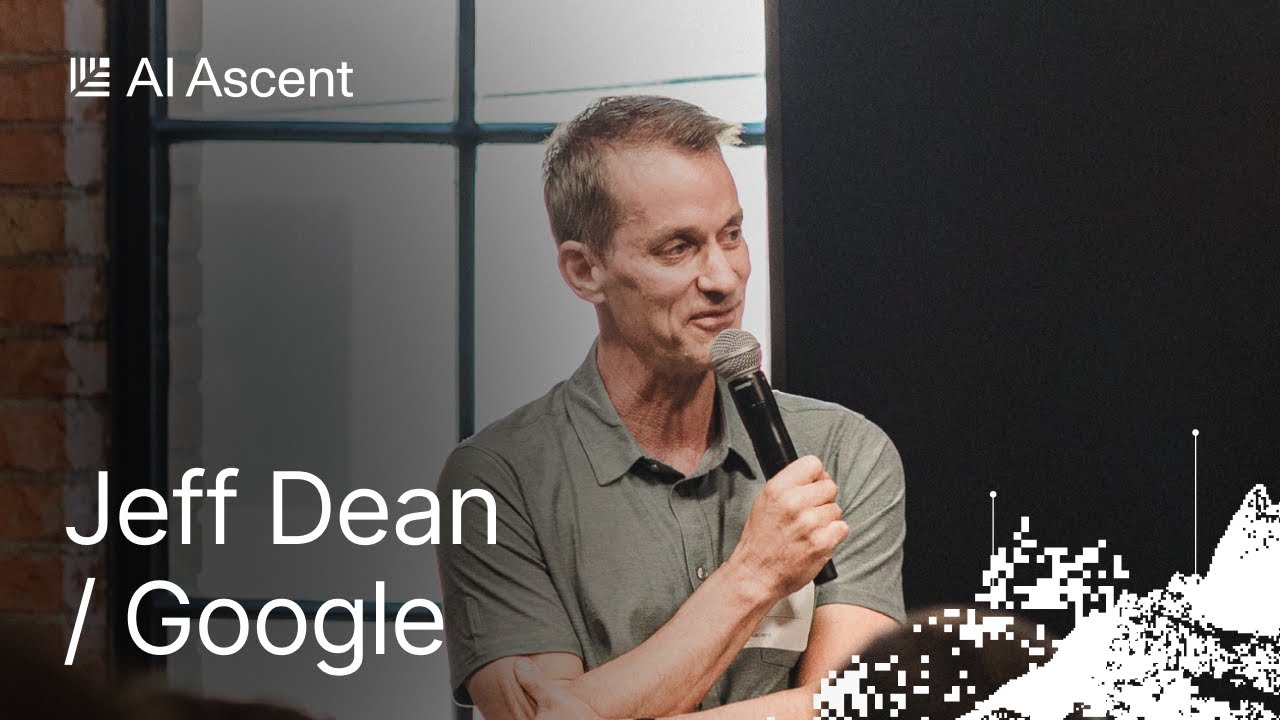
Google's Jeff Dean on the Coming Transformations in AI
Watch on YouTube ↗ Summary based on the YouTube transcript and episode description.
Google Chief Scientist Jeff Dean predicts AI junior engineers within a year and outlines a path to organic, sparse, self-reorganizing model architectures.
- Jeff Dean predicts AI will operate at junior engineer level within roughly one year, requiring tool use, test running, and debugging beyond code generation.
- Dean co-authored distillation research rejected from NeurIPS 2014; he notes it likely underpins DeepSeek’s efficiency gains.
- He bootstrapped Google’s TPU program in 2013 for inference; newest generation is Ironwood, just launching.
- Frontier model builders will number only a handful due to capital costs; distillation enables lightweight derivatives from those few.
- Mixture-of-experts models showed 10-100x efficiency gains per training flop in early Google work, but Dean argues current sparsity patterns are too regular.
- Dean envisions future models with dynamic, organic architectures: variable-cost paths, expandable parameters, and background distillation acting like garbage collection.
- Google’s Pathways system—single Python process driving tens of thousands of chips—is now being opened to cloud customers after years of internal-only use.
- AI simulators can approximate expensive physics/chemistry simulators at 300,000x speed, enabling screening of 10 million molecules over lunch instead of a year of compute.
2025-05-12 · Watch on YouTube