Sign of the future: GPT-5.5
TLDR
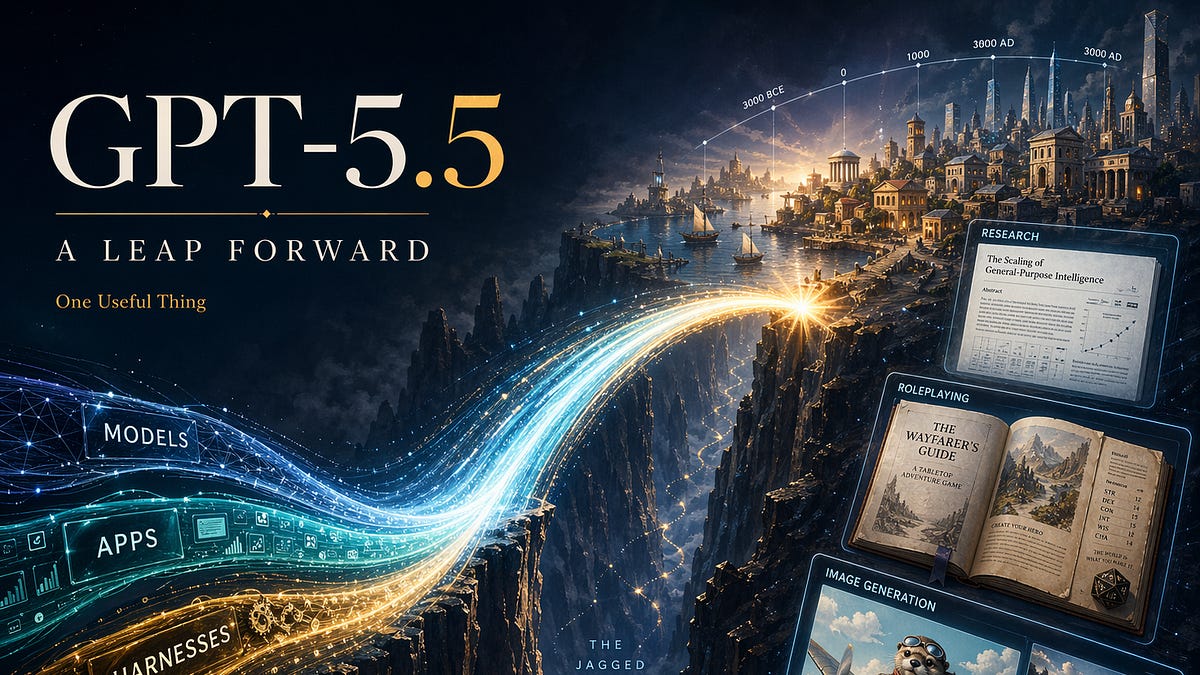
- GPT-5.5 Pro marks a measurable capability jump over prior models, completing a complex 3D simulation task in 20 minutes versus 33 for GPT-5.4 Pro.
Key Takeaways
- In a procedurally generated 3D harbor town challenge, only GPT-5.5 Pro modeled actual town evolution; earlier models just swapped buildings.
- Codex powered by GPT-5.5 produced a near PhD-quality academic paper on crowdfunding from four prompts, including a real literature review and sophisticated statistics.
- OpenAI’s new image model renders high-quality text inside images, enabling product mockups, slides, and illustrated documents without external tools.
- GPT-5.5 and Codex together generated a 101-page illustrated tabletop RPG rulebook, including simulated playtesting and rule revisions, from a single prompt.
- Long-form fiction remains a weak point: flat dialogue, unresolved complexity, and repetitive stylistic tics persist across GPT-5.5 outputs.
Why It Matters
- The capability gap between model generations is growing each cycle, not shrinking, which means previous benchmarks for “impossible” tasks keep becoming routine.
- Builders combining GPT-5.5 models, Codex as the app layer, and tool harnesses can now close decade-long research backlogs or prototype complex creative artifacts with minimal prompting.
- The jagged frontier is not gone: statistical sophistication and code generation outpace hypothesis quality and narrative coherence, so human judgment remains a real filter.
Ethan Mollick, One Useful Thing · 2026-04-23 · Read the original
