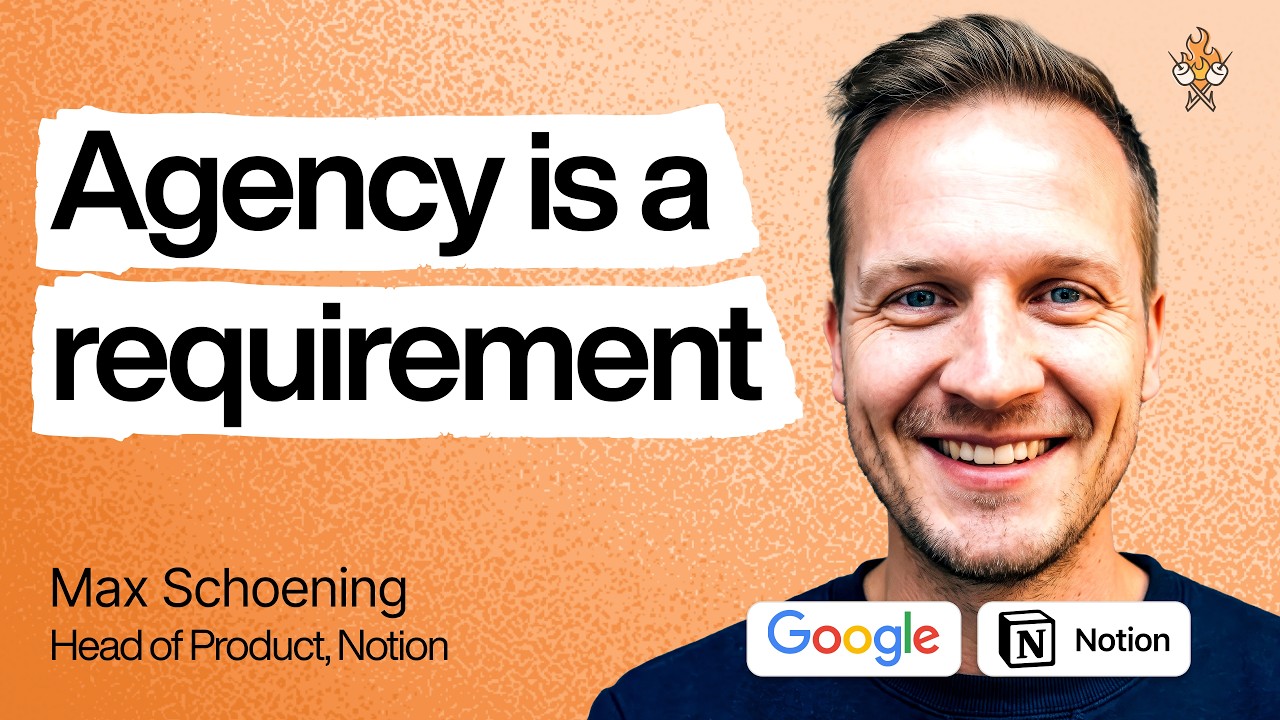
Max Schoening on agency, malleable software, and AI-era product building
Published 2026-05-02 - Runtime about 87 min - Watch on YouTube
TLDR
- Notion’s Max Schoening argues AI changes product work by making agency more important than formal roles.
- Useful for product leaders, designers, PMs, and engineers trying to build with AI instead of around it.
- The episode focuses on malleable software, prototypes, and why tiny product cores beat feature accumulation.
Key Takeaways
- Max says the first 10% of many projects is now free, changing how teams explore product ideas.
- Agency, not skill, is the separator: people who act on malleable software will outpace role-bound specialists.
- At Notion, designers and PMs prototype in code to understand the medium, not just ship more production changes.
- Great products have a tiny core, like GitHub’s pull request, Heroku’s deploy flow, and Dropbox’s menu bar icon.
- The SaaS apocalypse is overstated; the real gap is rising software quantity without matching quality.
Notes
- Max Schoening is head of product at Notion; he previously worked at Google, Heroku, GitHub, and co-founded two companies.
- Notion started moving designers from Figma chat mockups into a small, LLM-friendly code playground for prototyping.
- The playground was designed to be least scary and easy to one-shot, lowering fear of the terminal and codebase complexity.
- As model capabilities improved, designers and PMs began contributing more directly to the production codebase.
- Max thinks vibe coding has increased software volume more than software reliability or quality over the last 12 months.
- He cares about coding because it forces product people to understand the medium and agent loops, not because every prototype should ship.
- High agency at Notion looks like Brian Lovin blurring engineering and design while also recruiting for the org’s needs.
- Another example is Eric Liu, who moved from strategy docs to Figma and then toward building prototypes directly.
- Max warns that merging roles may reduce specialists unless teams remain intentional about craft and depth.
- He describes malleable software as having real ownership over computing life, instead of being locked into fixed app behavior.
- On product strategy, he says great products need a tiny core and that adding one more feature usually does not rescue a weak core.
- Examples he gives include Heroku’s git push flow, Dropbox’s sync icon, Snapchat’s disappearing photos, and Notion blocks.