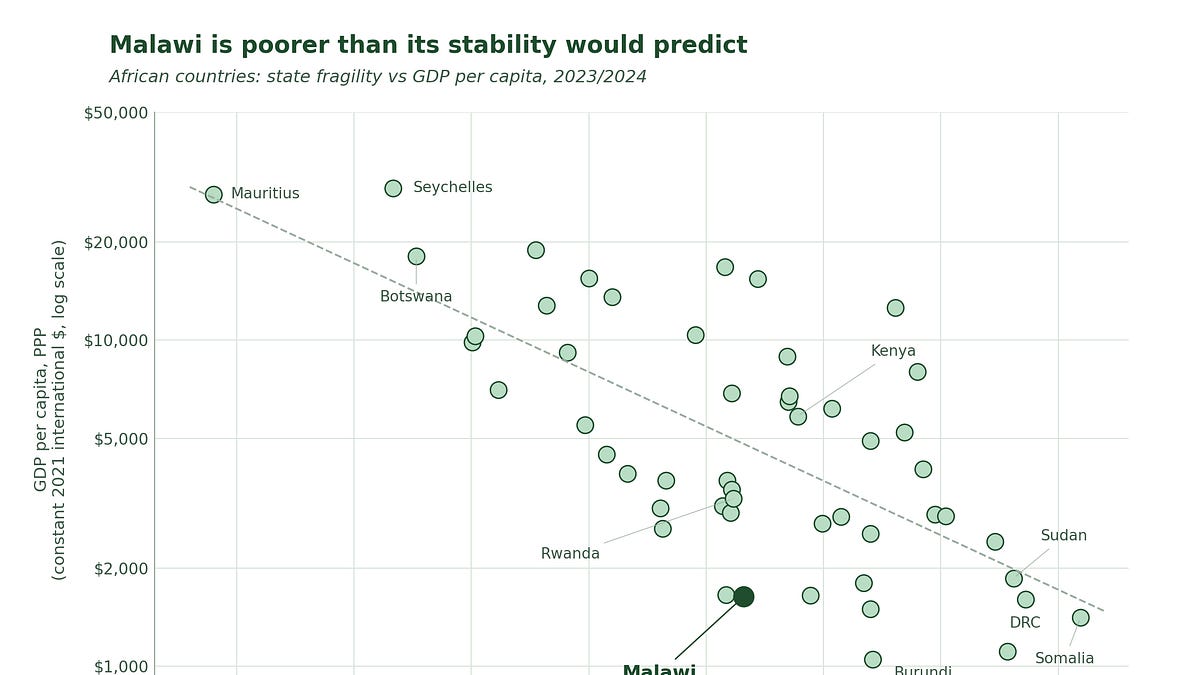
Malawi is among the world’s ten poorest countries by GDP per capita PPP, yet no single development theory cleanly explains why, despite peace, elections, and high aid flows.
Key Takeaways
Rwanda’s GDP per capita was 70% below Malawi’s in 1994; today Rwanda is roughly twice as rich, growing at ~4.5% real annually while Malawi shrank three consecutive years (2022-2024).
Standard explanations (landlocked geography, thin colonial inheritance, low human capital, commodity dependence on declining tobacco) describe poverty but don’t distinguish Malawi from peers who escaped.
Political-settlements theory (Dercon’s Gambling on Development) is the strongest candidate: the median voter is a smallholder maize farmer, locking in the FISP fertilizer subsidy and maize self-sufficiency policy over roads, irrigation, and crop diversification.
Customary land tenure administered by chiefs blocks plot consolidation, mortgaging, and sale to more productive farmers, keeping nearly everyone at subsistence scale.
Development economics has poor predictive power on which low-income countries grow: the East Asian miracle, Rwanda, and Botswana were all surprises; Malawi’s stagnation was not obviously foreseeable in 1990.
Hacker News Comment Review
Commenters split on whether Rwanda’s divergence is explained by Kagame’s developmentalist authoritarianism or by outsized foreign aid inflows; both factors likely compound, and neither is replicable on demand.
Several commenters challenged the Transparency International corruption ranking as a poor cross-country signal, noting it tracks press coverage more than actual extractive behavior, making Malawi’s middling score less reassuring than the article implies.
A recurring thread questioned the circular reasoning critique: in development contexts, low agricultural productivity and absent capital markets can be self-reinforcing traps rather than mere tautologies, closer to a credit-denial equilibrium than a definitional fallacy.
Notable Comments
@xandrius: Points to export composition (tobacco 55%, dried legumes, sugar vs. Rwanda’s gold, tin, rare earths) as a concrete structural signal the article underweights.
@alephnerd: Argues Rwanda’s aid-to-GNI ratio significantly exceeded Malawi’s and peer Southern/Eastern African countries, suggesting Rwanda’s model is less transferable than commonly cited.