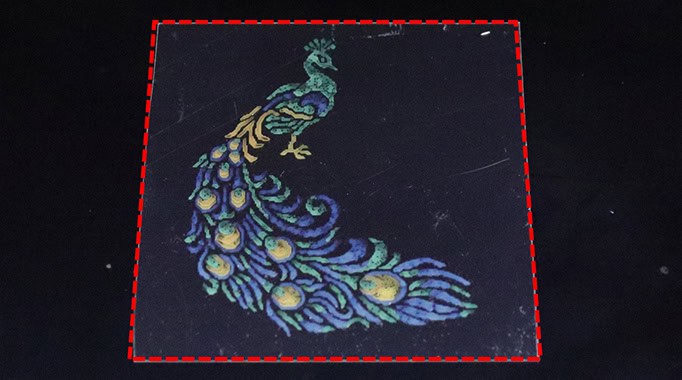
Paper in Advanced Materials (Kobe University) demonstrates inkjet-printable Mie-resonant silicon nanoparticle ink that produces structural colour on flat and 3D surfaces without fading.
Key Takeaways
Crystalline silicon nanoparticles (100-200 nm diameter) coated in thick silica shells prevent aggregation while preserving Mie-resonant structural colour output.
Printed images show optical asymmetry: different colours in transmission vs. reflection, a property typically considered mutually exclusive in a single material.
Hue is tunable by changing nanoparticle diameter, enabling multi-colour patterns from a single inkjet process at 125-250 dpi.
Unlike pigment-based inks, structural colour does not fade unless the nanostructure is physically damaged, and the ink is non-toxic and water-based.
Target applications include anti-counterfeiting films, semi-transparent smart windows, and passive displays that reveal printed content only when a monitor is off.
Hacker News Comment Review
No substantive HN discussion yet; the single comment flags complexity of the underlying plasmonics literature and draws a historical parallel to Lippmann plates as a prior diffraction-based colour photography technique.