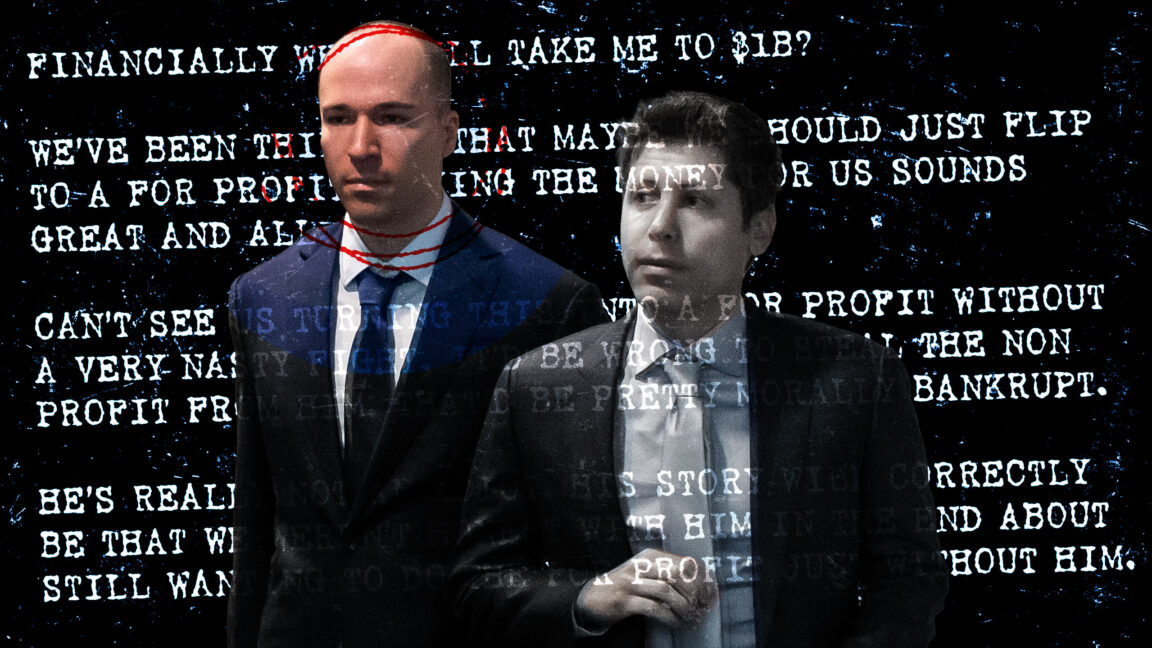
Greg Brockman testified under oath, reading personal journal entries aloud in court as Elon Musk’s legal team argued they prove OpenAI abandoned its nonprofit mission for personal enrichment.
Key Takeaways
Brockman’s 2017 journal entries include “Financially, what will take me to $1B?” and musings about flipping OpenAI to for-profit, used by Musk’s attorney as evidence of mission abandonment.
A key entry reads “It’d be wrong to steal the non-profit from him. That’d be pretty morally bankrupt” – Brockman testified this applied only to a forced removal of Musk, which never occurred; Musk left voluntarily in 2018.
Brockman’s stake in OpenAI is now worth ~$30 billion; Musk’s attorney repeatedly asked him to justify keeping it versus returning $29B to the nonprofit arm.
Brockman testified Musk’s departing all-hands speech was designed to tank morale, and that Musk admitted he would cut corners on AI safety at Tesla to keep pace with Google.
Journals were kept on a work laptop, swept up in discovery, submitted as sealed evidence in October, then unsealed in January.
Hacker News Comment Review
Commenters broadly agree the “steal the non-profit” and “morally bankrupt” lines are the most damaging entries regardless of Brockman’s contextual defense.
A recurring concern: personal journals stored on work devices have no discovery protection – Brockman’s case is a concrete cautionary example for anyone at a high-stakes org.
Several commenters noted the broader privacy implication that AI chatbot logs used as journaling substitutes face the same legal exposure, sitting on third-party cloud infrastructure with no privilege protection.
Notable Comments
@brap: “It’s beyond me how these super important (and controversial) people keep diaries where they lay out their evil plots like a villain from Scooby Doo. And save it on a work computer.”
@jeffwask: Confirms the mechanism – work laptop discovery – and frames it as a security policy failure, not just bad luck.