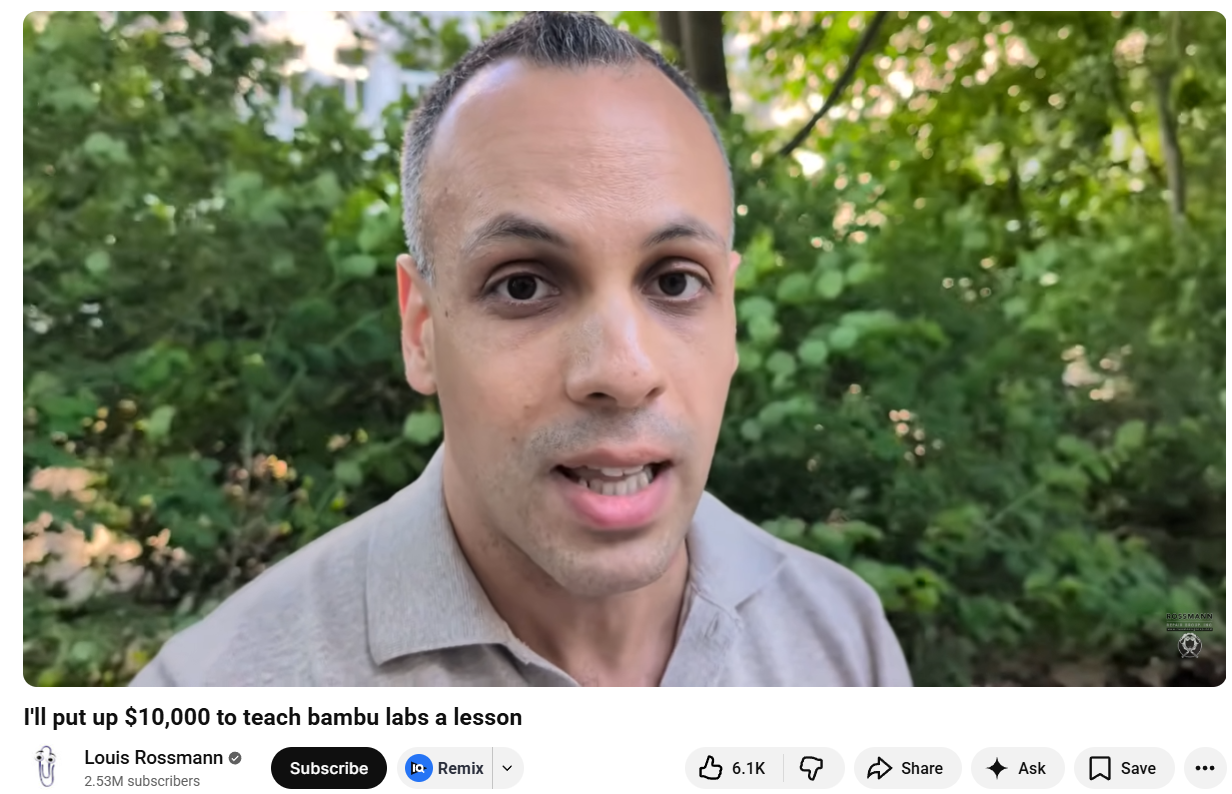
Louis Rossmann pledged $10,000 toward legal defense for Pawel Jarczak, whose OrcaSlicer-BambuLab fork was killed after a Bambu Lab cease and desist threat.
Key Takeaways
Jarczak’s fork restored direct OrcaSlicer-to-printer control; Bambu Lab cited ~30 million daily unauthorized cloud requests as justification for the C&D.
Rossmann is asking Jarczak to restore the GitHub repo in defiance, with crowd-funded legal backing if Bambu Lab pursues litigation.
Bambu Lab previously reversed a plan to eliminate offline access entirely only after public backlash, signaling a pattern of user-hostile policy.
Bambu printers have a history of repair-hostile design: glued parts, non-replaceable carbon rods, complex hotend swaps – though newer H2D/X2D models improved some of this.
No crowdfund is live yet; Rossmann is gauging community commitment before directing Jarczak to act.
Hacker News Comment Review
Commenters broadly agree Bambu’s legal position is weak, but some note the fork was calling private cloud APIs while impersonating Bambu Studio – a technical distinction that complicates the clean Right to Repair framing.
Multiple X1C owners report air-gapping their printers on isolated networks post-controversy; the forced-cloud architecture is the core grievance, not just repairability.
Rossmann himself is divisive: supporters cite his financial commitment as genuine; critics argue his channel has shifted to pure outrage and drama over substantive repair content.
Notable Comments
@RobotToaster: Notes Bambu’s proprietary networking plugin uses AGPL slic3r/PrusaSlicer libraries without releasing source – a potential AGPL violation.
@sottol: Points to Bambu attempting to patent widely used 3D printing techniques in China, linking a journal reference as evidence.