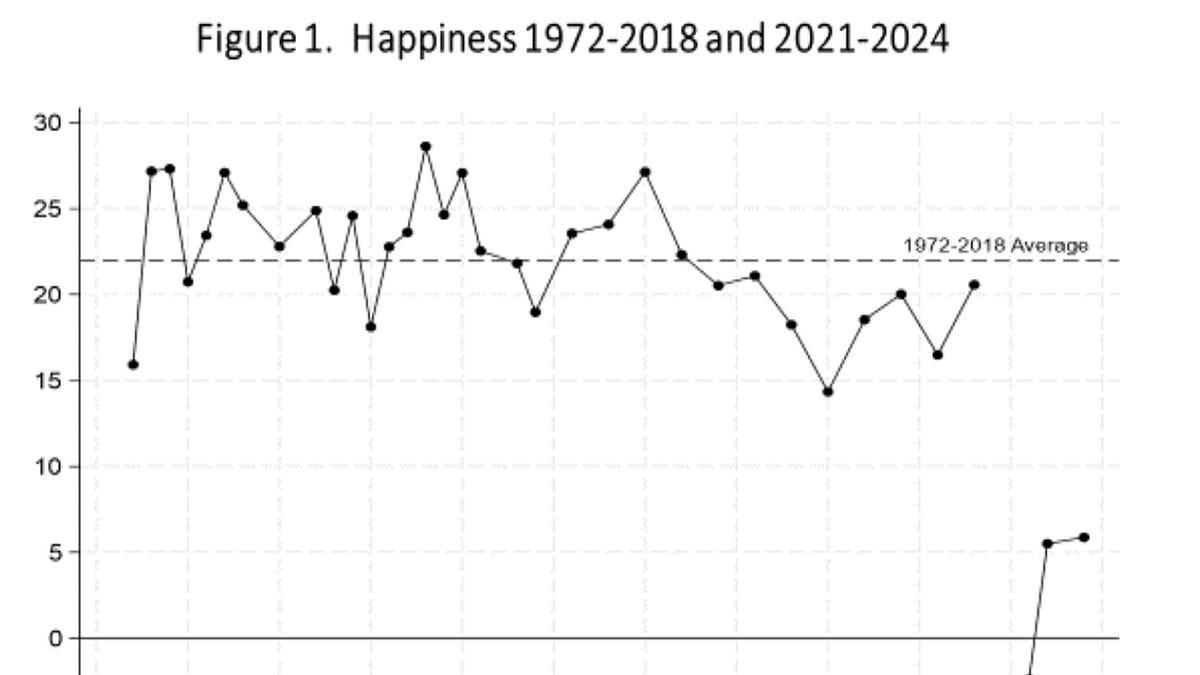
Economist Sam Peltzman documented a sudden, historically unprecedented post-COVID collapse in US self-reported happiness that has barely recovered through 2024.
Key Takeaways
Peltzman calls it a “regime change”: a uniform 10-15 point happiness decline hitting every demographic, not concentrated among young, poor, or unmarried groups.
Four independent datasets converge: the GSS, the Federal Reserve worker satisfaction survey (lowest since 2014), the U Michigan consumer sentiment index (lowest in 70-year history), and the World Happiness Report.
Consumer prices rose 25% from 2020-2025, matching the entire 2007-2020 period; home prices rose 50% in the same five years, matching 2004-2020 combined.
Matt Darling’s analysis shows the richest third’s sentiment dropped most relative to predictions: full employment raised the price of low-wage services they once accessed on demand.
Anglophone nations (US, Canada, UK, Ireland, Australia, New Zealand) show disproportionate well-being declines; cultural individualism and diagnostic inflation are named as amplifiers.
Hacker News Comment Review
Commenters broadly agree the 2020 inflection point is real but split on cause: inflation and affordability versus social fabric collapse from COVID lockdowns destroying relationship density.
A recurring thread argues AI career anxiety is a live compounding factor that the article underweights: workers feel replaceable and future income is uncertain regardless of current employment stats.
Several commenters push back on the wealth framing entirely, noting aggregate GDP growth obscures that the bottom 40% net negative wealth position makes happiness averages misleading.
Notable Comments
@bontaq: Argues day-to-day working conditions degraded independently of macro stats: remote gone, real pay down, AI pressure constant, “nobody can take a break.”
@xyzelement: Offers a direct comparison between atheist and religious FAANG directors at the same income level to argue community structure, not income, drives the gap.
@tracker1: Points to cultural fragmentation: 50 years ago near-universal shared media (“I Love Lucy”) created cohesion; fragmented streaming and political media dissolved it.