
Why Space Elevators Can't Mine Black Holes – Adam Brown
Watch on YouTube ↗ Summary based on the YouTube transcript and episode description.
Adam Brown explains why the laws of physics forbid ropes strong enough to mine black holes, and why small black holes could be near-100%-efficient power plants.
- A solar-mass black hole left alone takes 10^55 times the current age of the universe to radiate away its energy via Hawking radiation.
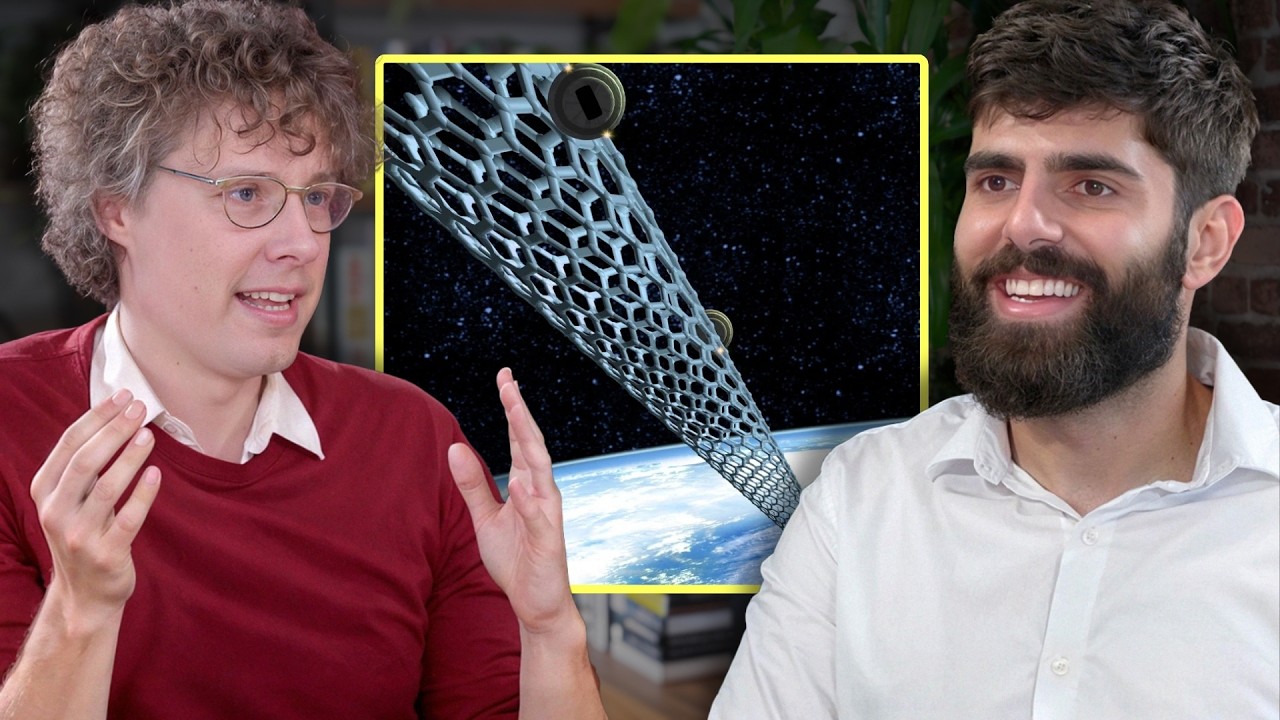
- Proposed fix: dangle a rope near the event horizon to drag radiation away — effectively a black-hole space elevator — but material science kills it.
- Carbon nanotubes barely work for an Earth space elevator; they score ~10^-12 on the tensile-strength-to-mass ratio needed for a black hole rope — nowhere close.
- The speed of light sets a hard upper bound on tensile strength per unit mass (c²); a fundamental string from string theory saturates that bound but has zero leftover strength to carry any payload.
- Black hole temperature is inversely proportional to size, so smaller black holes radiate faster and are more useful as near-term energy sources.
- Chemical reactions extract ~1 part in 10 billion of MC²; nuclear fission ~1 part in 1,000; both are limited by baryon number conservation.
- Only gravity violates baryon number: throwing protons and neutrons into a small black hole converts their full rest mass into photons, gravitons, and neutrinos — approaching 100% MC² efficiency in principle.
2025-01-14 · Watch on YouTube