Michael Nielsen – Why aliens will have a different tech stack than us
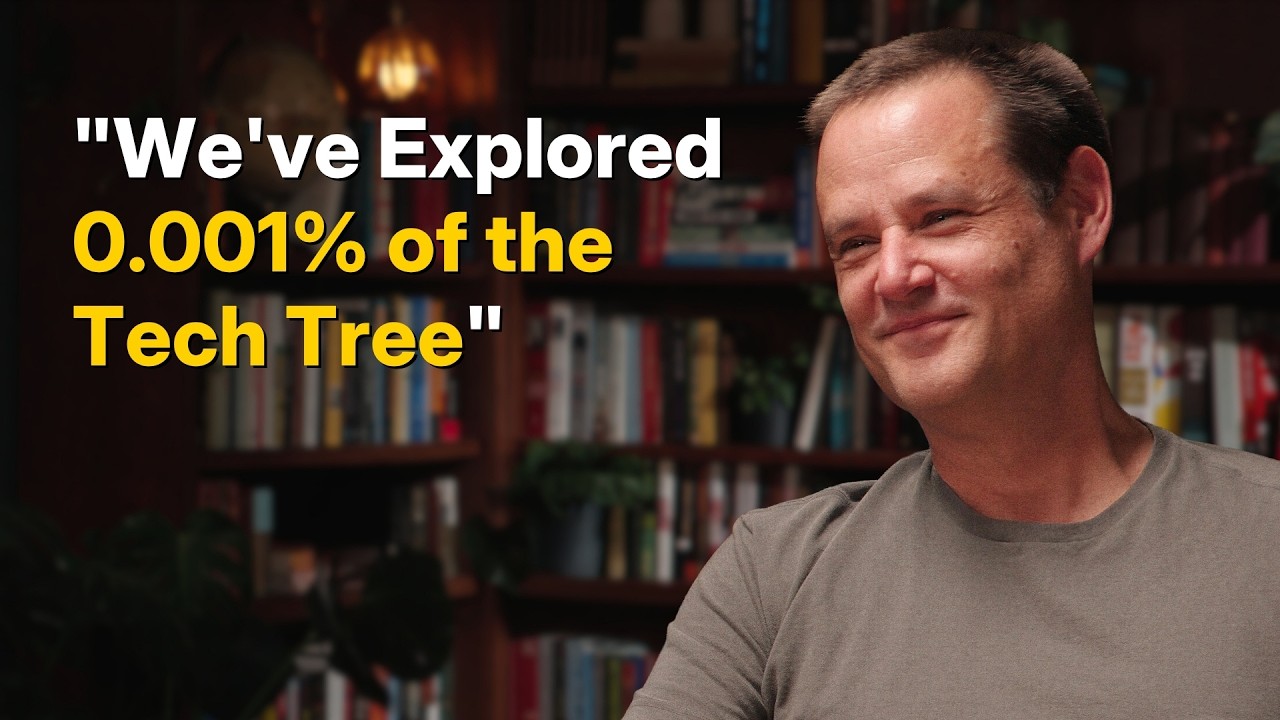
Michael Nielsen argues that aliens will have a radically different science and tech stack than humans, challenging the assumption of a universal linear tech tree.
- Nielsen argues alien civilizations likely developed entirely different science and technology stacks, implying no universal linear tech tree and complex implications for inter-civilizational trade.
- Einstein likely did not use the Michelson-Morley experiment as motivation for special relativity — Lorentz had the same math but kept an ether interpretation that was empirically indistinguishable until muon decay experiments circa 1940.
- Aristarchus proposed heliocentrism in the 3rd century BC; stellar parallax confirming it wasn’t measured until 1838 — a 2,000-year verification loop that science effectively short-circuited.
- Copernicus’s model was neither more accurate nor simpler than Ptolemy’s at the time — it actually required more epicycles — yet scientists correctly preferred it via non-experimental heuristics.
- AlphaFold’s real story is decades of expensive experimental protein structure acquisition (~180,000 structures, several billion dollars); the AI component was a small fraction of total investment.
- Darwin and Wallace independently converged on natural selection in the 1850s; the enabling precondition was Lyell’s 1830s discovery of deep geological time — without millions of years, evolution is a non-starter.
- Nielsen entered quantum computing in 1992 when almost nobody worked on it, guided by Deutsch’s 1985 paper; von Neumann could have invented quantum computing in the 1950s but lacked the convergence of cheap PCs and ion-trap hardware.
- Simonton’s equal-odds rule: any given publication has roughly equal probability of being extremely important, so total output volume is the main predictor of career impact.
2026-04-07 · Watch on YouTube