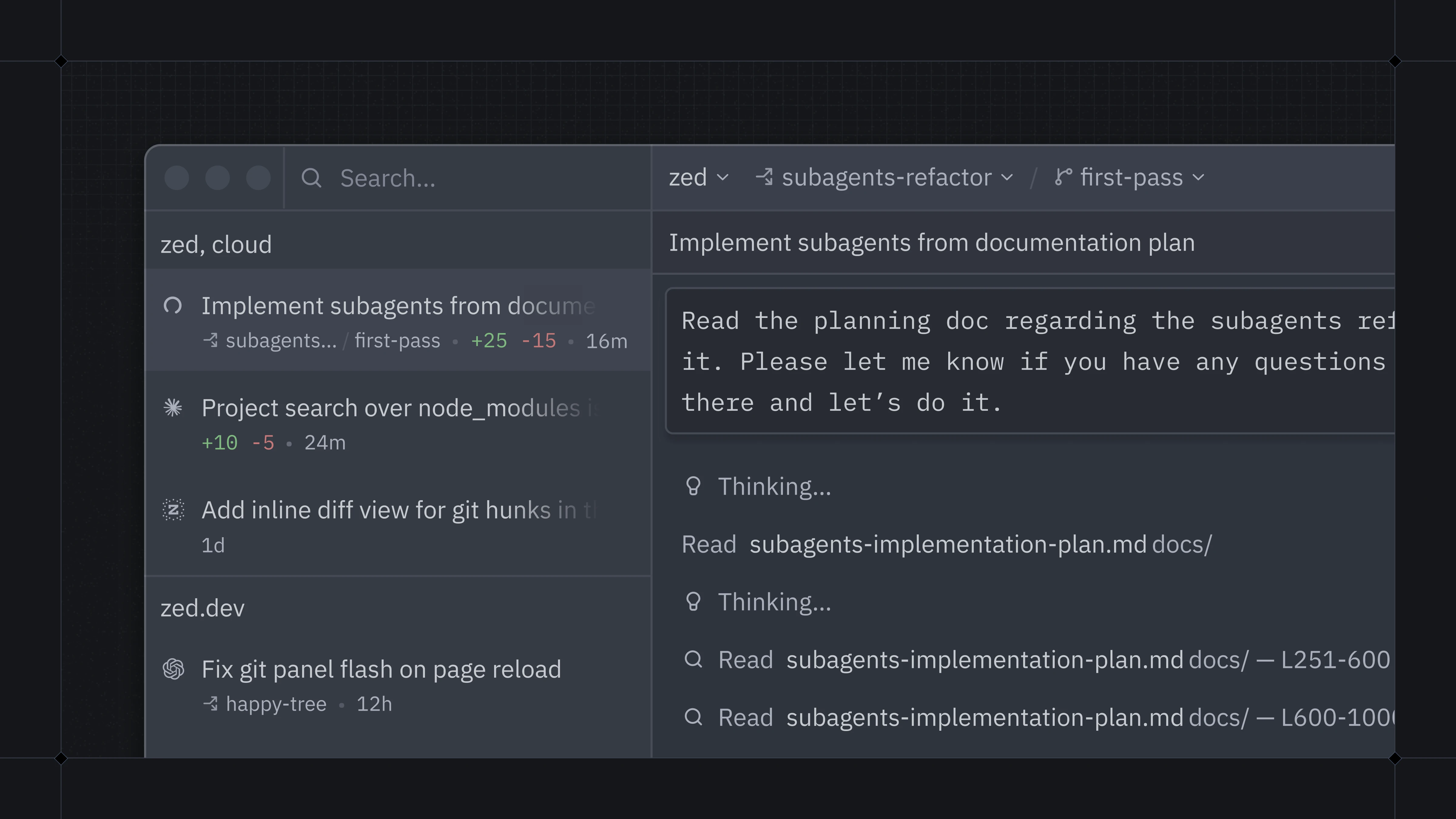
Zed ships a parallel agents UI built on git worktrees, letting multiple AI threads run isolated tasks simultaneously.
Key Takeaways
Zed’s parallel agent feature is built on git worktrees, giving each agent thread a fully isolated working directory.
The editor is agent-agnostic, meaning it works with Claude, Codex, and others rather than locking into a first-party model.
Zed supports multiple repositories on the same agent by auto-creating a worktree per repo, per HN commenters.
The default layout pushes code and filetree aside to surface AI panels, a deliberate UX shift from Zed’s historically minimal AI stance.
Warp launched a comparable parallel-agent feature roughly a week earlier, making this a fast-converging pattern across dev tools.
Hacker News Comment Review
The strongest signal from commenters is that the workflow value multiplies when worktree lifecycle hooks automate environment setup: copying config files, cloning local Postgres databases per worktree, and tearing them down on close. Without that automation layer, parallel agents are just parallel terminals.
There is genuine split between power users who find parallel agents transformative and developers who prefer deep focus on one thread, with the latter questioning whether this needs to be a primary interface paradigm at all.
Zed’s Windows support drew skepticism: despite native-code claims, the title bar and hover-triggered menubar felt non-native to Windows users, weakening the “not Electron” pitch.
Notable Comments
@jamie_ca: describes full worktree automation with Postgres DB cloning per thread and teardown on close as the actual workflow unlock.
@jotato: “Yesterday, I determined to move to Zed because they weren’t pushing this stuff” – dissatisfied by the direction shift.