Boris Cherny on Claude Code, agent workflows, and the post-code era
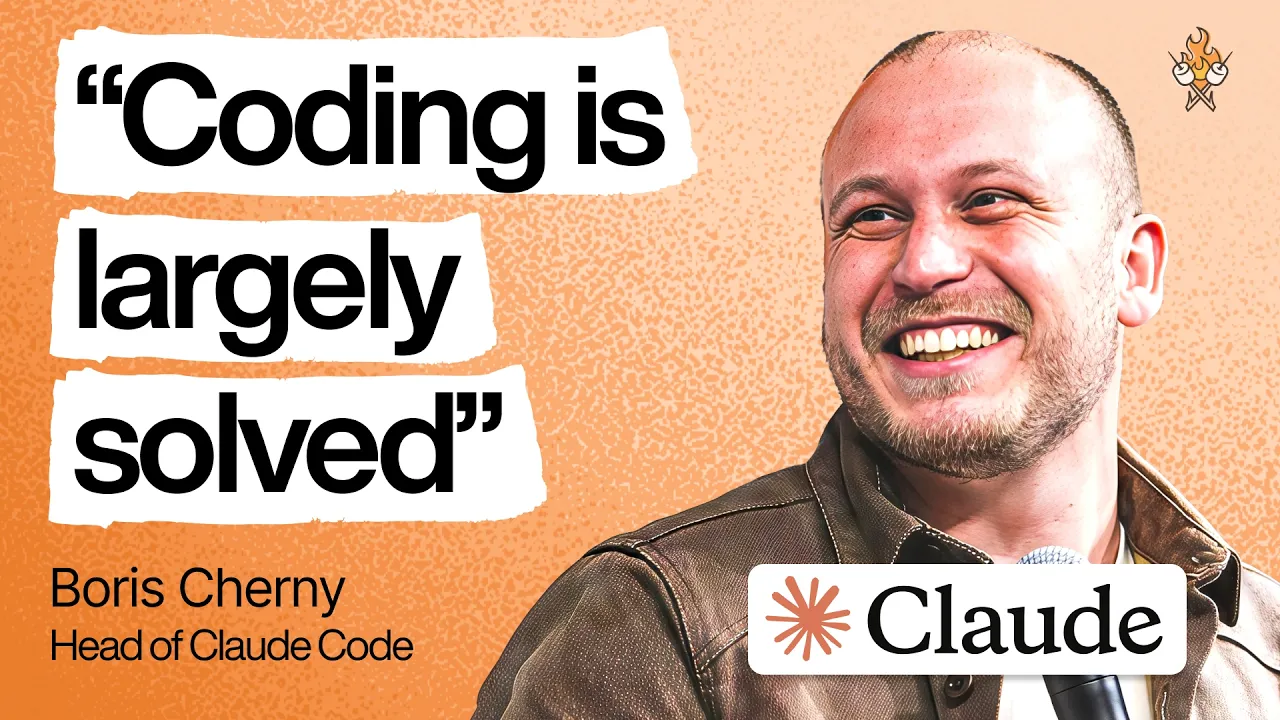
Published 2026-02-19 - Runtime about 88 min - Watch on YouTube
TLDR
- Boris Cherny says Claude Code shifted engineering from writing code to choosing what should exist, with agents now handling PRs and debugging.
- Claude Code’s growth accelerated to 4% of public GitHub commits, while Anthropic says private-repo usage is likely higher.
Key Takeaways
- Boris left Anthropic for Cursor because he admired the product, then returned after two weeks when Anthropic’s safety mission felt irreplaceable.
- Claude Code started as a terminal prototype called ClaudeCLI, built under-resourced, then expanded after users embraced the terminal form factor.
- Anthropic says productivity per engineer rose 200% and the engineering team was about 4x larger after Claude Code adoption.
- Boris advises building for the model six months out, giving models tools instead of rigid workflows, and betting on the more general model.
Notes
- Claude Code began as a quick hack, not a planned product; Boris first spent time prototyping, then doing post-training work to understand the model layer.
- Early internal reaction was minimal: Boris announced the first version internally and got two likes.
- The product launched in the terminal because it was easiest for a one-person build, and the terminal stayed because the model was improving too fast for heavier UI bets.
- The first surprising demo used a batch tool to answer what music he was listening to, showing the model could figure out tool usage without explicit instruction.
- Boris ties Claude Code’s success to latent demand: it met engineers where they already worked and made existing workflows easier.
- Claude Code later expanded to iOS, Android, desktop, web, IDE extensions, Slack, and GitHub.
- Anthropic sees Claude Code as part of a broader shift from coding to tool use to computer use, with Cowork extending that pattern to non-technical users.
- Boris says current models can run unattended for 10 to 30 minutes on average, and sometimes for hours, days, or even many weeks.
- A newer teammate used Claude Code to diagnose a memory leak faster than Boris could using traditional heap-snapshot debugging.
- Boris’s team principle of underfunding projects slightly is meant to force creativity and make people use Claude to automate the work.
- He warns against boxing models into rigid workflows; instead, give them a goal and tools so they can fetch context themselves.
- His preferred product advice is to build for the model six months from now, accept weaker early PMF, and ship when the next model arrives.
- For users, he recommends starting with small tasks, then connecting tools, then running many tasks in parallel; he uses Cowork for email, Slack, spreadsheets, and project management.