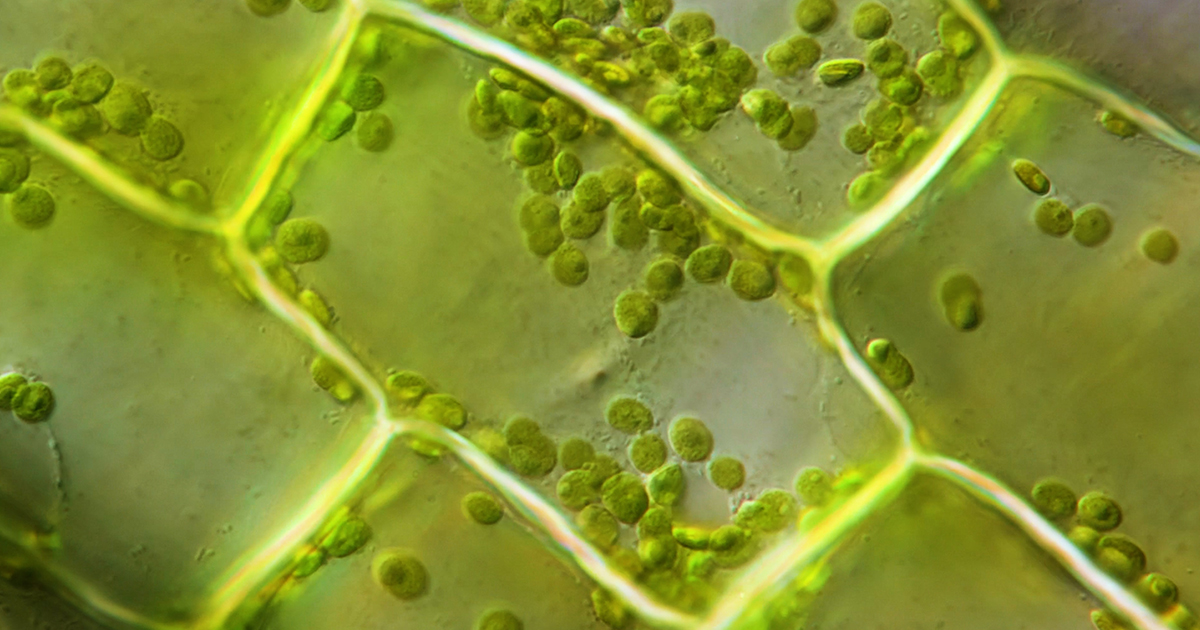
PNAS 2025 paper finds chloroplasts in Elodea self-organize at a mathematically optimal packing density, balancing photosynthesis and light-damage avoidance.
Key Takeaways
Chloroplasts solve a disc-packing problem: dense enough to absorb light, sparse enough to move and hide when intensity spikes hundredfold.
Elodea cells operate at a glass-transition critical point: stable and solid under constant light, fluidlike when light intensity changes, enabling rapid chloroplast repositioning.
3D clustering behind other chloroplasts for protection only works because the cell interior becomes fluidlike first, a finding from the 2023 companion paper.
Chloroplast motion traces back 3 billion years to endosymbiosis; the physics of that motion was largely unexplored until this lab’s work.
Emergence and packing problems (Kepler-style) frame the biology: simple organelle interactions produce optimized large-scale cellular organization.