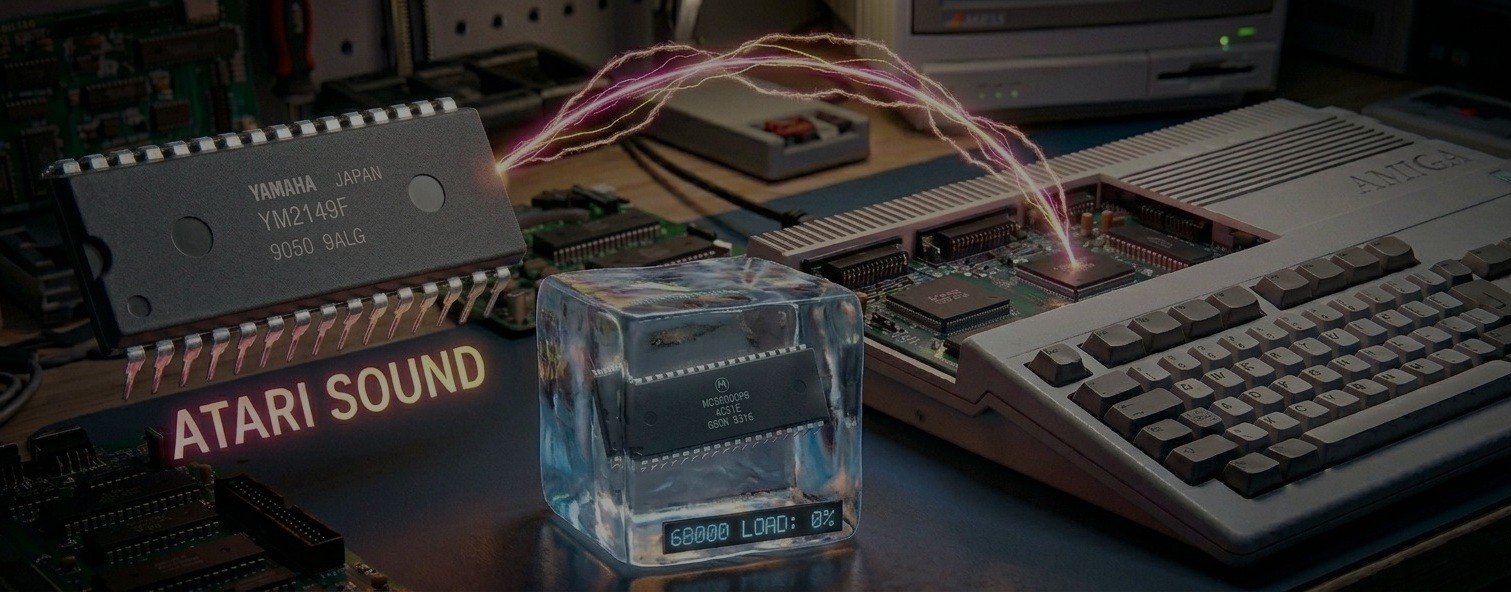
Arnaud Carré emulates the Atari YM2149 on Amiga PAULA at 0 CPU cost by reversing the roles of PAULA’s attached-voice modulator and PCM sample data.
Key Takeaways
PAULA’s rarely used “attached voice” mode lets one channel volume-modulate another; swapping the triangle wave to 8-bit PCM and the square wave to the 16-bit modulator slot solves the resolution problem that makes naive use sound coarse.
The YM2149 MadMax Buzzer effect (used in tracks like “Leavin Teramis”) combines a detuned square wave with the chip’s single hardware envelope to produce sweeping, complex timbres – the emulation captures this faithfully.
All PAULA state (period, volume, modulator data) is pre-computed offline on PC from .sndh files at 50 Hz frames, identical in approach to Carré’s LSP ultra-fast MOD player, so the Amiga 68000 touches zero audio logic per frame.
Prior approach in the 2020 AmigAtari demo consumed ~50% of frame time emulating YM2149 plus Atari hardware timers; the new method frees that budget entirely for sin-dots rendering.
Only one known demo had previously used PAULA pitch modulation; volume modulation in attached mode appears to have no known prior use in games or demos.