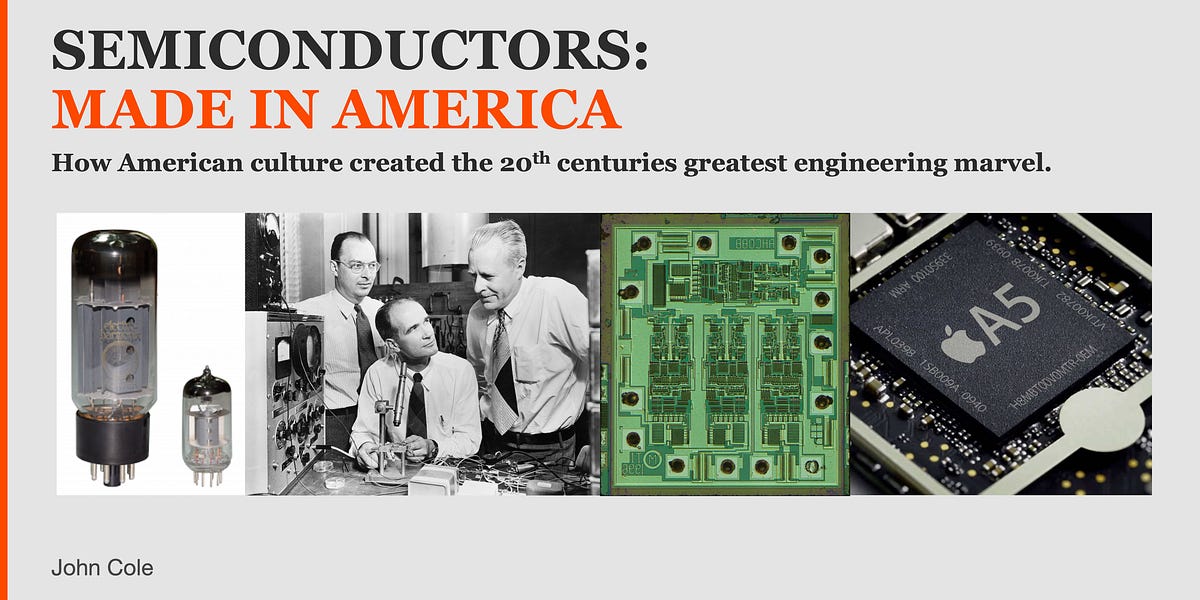
Talk given in Almaty, Kazakhstan for America’s 250th, tracing semiconductor history from Edison’s photoelectric effect through Bell Labs, Shockley, and the cell-division spawning of Silicon Valley.
Key Takeaways
Edison discovered the photoelectric effect at Menlo Park but didn’t pursue it; Bell Labs, modeled on Menlo Park, is where Shockley invented the transistor.
Shockley’s talent for attracting and repelling brilliant engineers drove the spinout dynamic that seeded Silicon Valley’s company ecosystem.
Author argues core American cultural traits – free speech, irreverence toward hierarchy, meritocracy, openness to outsiders – were necessary conditions for this engineering outcome.
The Silicon Valley origin story is framed as a product of immigrants, antitrust law, and idealism, not just technical genius.
Hacker News Comment Review
The “only in America” thesis draws pointed pushback: the civil rights era context and systemic exclusions make meritocracy claims hard to square with actual history.
Some commenters accept the cultural-conditions framing as interesting but question its rigor; others reduce it to a tax and freedom argument with little supporting evidence.
Notable Comments
@hgoel: “freedom and meritocracy” claims clash sharply with pre-civil-rights-era realities and documented treatment of Black Americans during the same period.