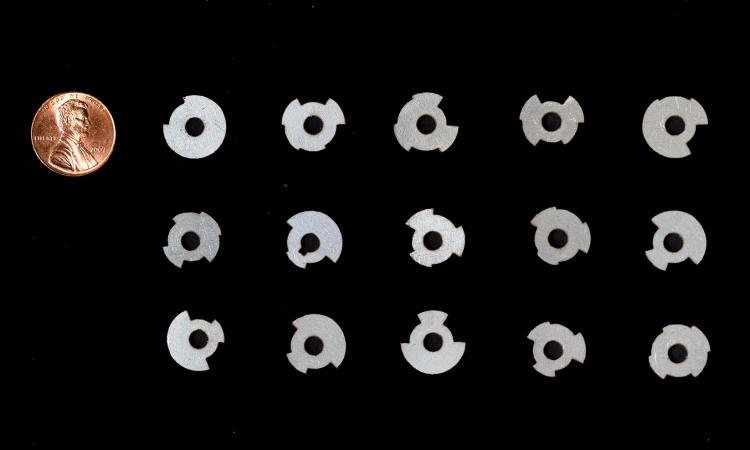
Georgia Tech paper in ACM IMWUT introduces penny-sized passive metal tags that emit unique ultrasonic fingerprints on impact, enabling battery-free activity recognition.
Key Takeaways
Tags are stamped metal disks (washer-shaped with cutouts) costing cents each; geometry determines resonant ultrasonic frequency above 20 kHz, inaudible to humans.
Simulation tool identified ~1,300 unique frequency designs; lab tests used 15, with researchers confident thousands are feasible across the ultrasound spectrum.
Detection accuracy: 93.75% in controlled conditions, 92.1% in realistic deployment; detection range is capped at ~1 meter by ultrasound physics.
Receiver must be a nearby wearable or microphone-equipped device; no ML required – a hardcoded rules algorithm handles signal identification at low compute cost.
The 1-meter range limit is the core deployment constraint; requiring every occupant to wear a receiver undercuts the plug-and-forget smart home pitch, per several commenters.
Commenters noted this echoes the 1956 Zenith Space Commander remote, which used struck tuned metal bars at ultrasonic frequencies – the same physical principle, decades old.
Practical concerns raised: smartphone microphones typically cap at 44.1–96 kHz, squeezing the usable fingerprint spectrum; and mechanical metal tags will wear or detune over time, threatening accuracy.
Notable Comments
@anVlad11: flags 92-93% accuracy as too low for reliable automation triggers, and notes the wearable-receiver requirement as a consumer-unfriendly constraint.
@superxpro12: most smartphone mics cap at 48 kHz sample rate, tightly limiting available fingerprint frequency space for real-world deployment.