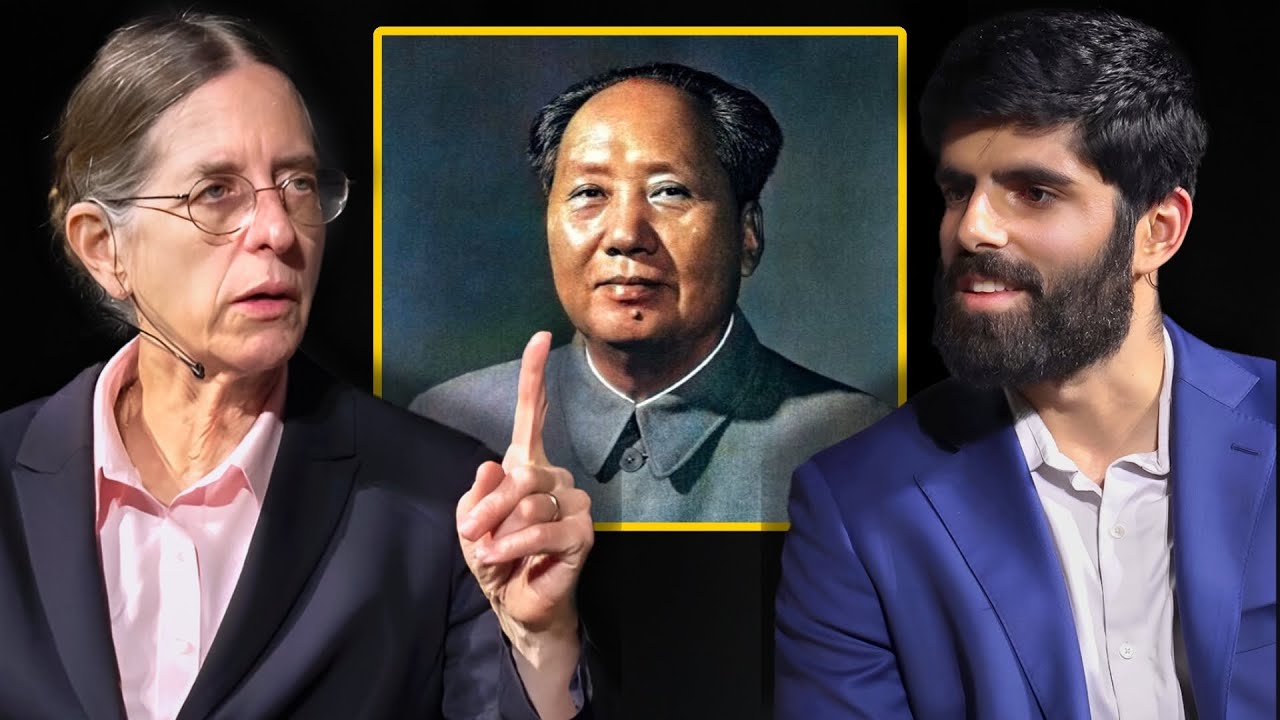
"The Brilliance of Communism" – Sarah Paine
Watch on YouTube ↗ Summary based on the YouTube transcript and episode description.
Sarah Paine explains why Communist party systems are uniquely effective at holding power while guaranteeing poverty, using Mao, Xi, and Stalin as case studies.
- Communism’s core innovation is party/commissar system: extremely effective at seizing and retaining power, but structurally produces poverty.
- North Vietnam won its war then immediately triggered famine—even in a country with three annual harvests.
- Mao launched the Cultural Revolution specifically because Khrushchev’s 1956 Stalin denunciation showed him what happens to dead leaders’ legacies.
- Mao mobilized teenage Red Guards by telling them they were in charge; they began by killing teachers, then gutted the entire education system.
- Xi Jinping’s father was purged but not killed; Xi’s cultural-revolution experience left him poorly educated but a genuine true believer in communism.
- Xi is now recentralizing China’s economy back toward pre-Deng Xiaoping orthodoxy, not just invoking Mao rhetorically.
- Mao’s portrait still hangs in Tiananmen and he is revered in ways Hitler and Stalin are not in their own countries, despite comparable death tolls.
- Paine attributes Xi’s lack of mercy partly to psychopathy, noting Stalin and Hitler also suffered childhood abuse without developing empathy.
2025-02-01 · Watch on YouTube