
How Black Holes Reveal a Holographic Reality
Watch on YouTube ↗ Summary based on the YouTube transcript and episode description.
Adam Brown explains how the Bekenstein-Hawking bound implies our universe may be a hologram, and why AdS/CFT doesn’t describe the universe we actually live in.
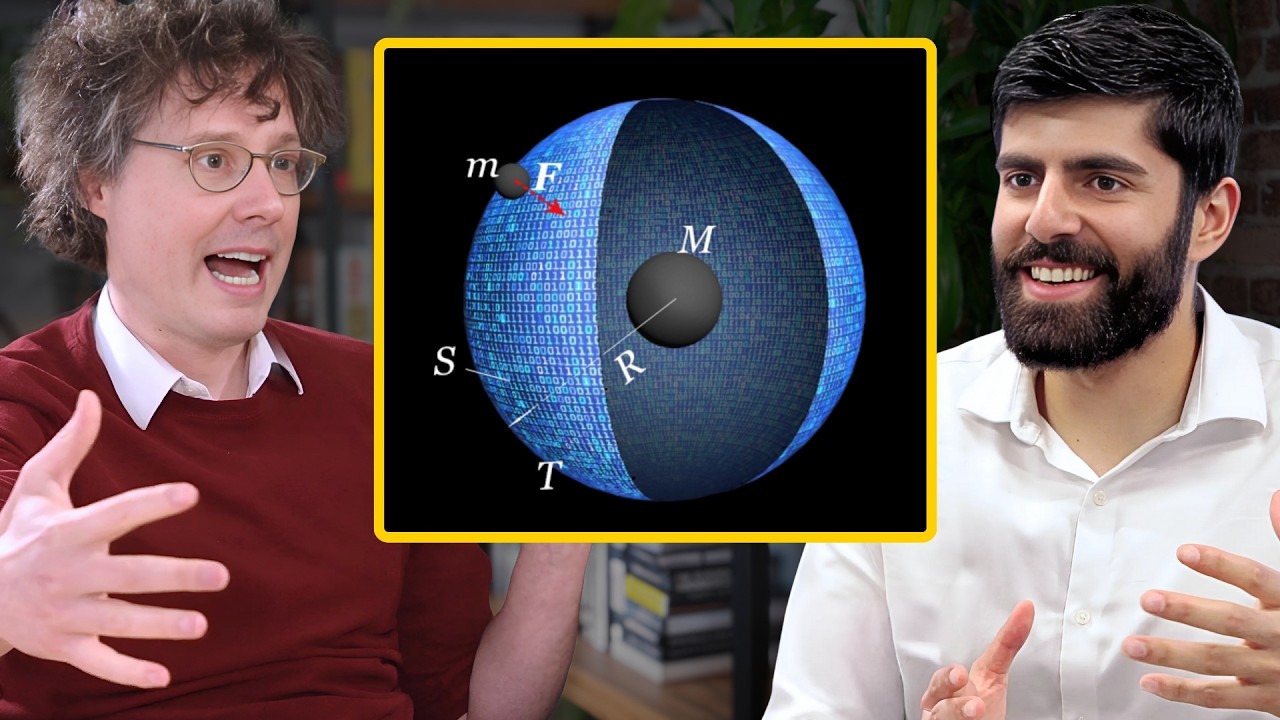
- The maximum information storable in any region is Area/(4G·ℏ) — area, not volume — the single most confident fact about quantum gravity.
- Black holes maximize information storage; piling hard drives never comes close to violating the bound before gravitational collapse occurs.
- The area-scaling of entropy is the empirical basis of the holographic principle: a gravitational theory in N dimensions is equivalent to a non-gravitational theory in N-1 dimensions.
- Maldacena’s AdS/CFT correspondence is the most cited paper in theoretical physics and provides an exact duality, not an approximation.
- AdS/CFT does not describe our universe: it requires a negative cosmological constant; ours has a positive one.
- The duality runs both directions — RHIC gold-atom collisions (quark-gluon plasma) are sometimes easier to compute as simple black hole properties in the dual gravitational theory.
- In a universe like ours, the boundary theory might live on the cosmological horizon, but each observer has a different horizon, meaning everyone sits on everyone else’s boundary.
- Brown treats AdS/CFT as a precise isomorphism, not a metaphor — both descriptions are equally real, neither more physically fundamental.
2024-12-31 · Watch on YouTube