Building pi in a World of Slop — Mario Zechner
Watch on YouTube ↗ Summary based on the YouTube transcript and episode description.
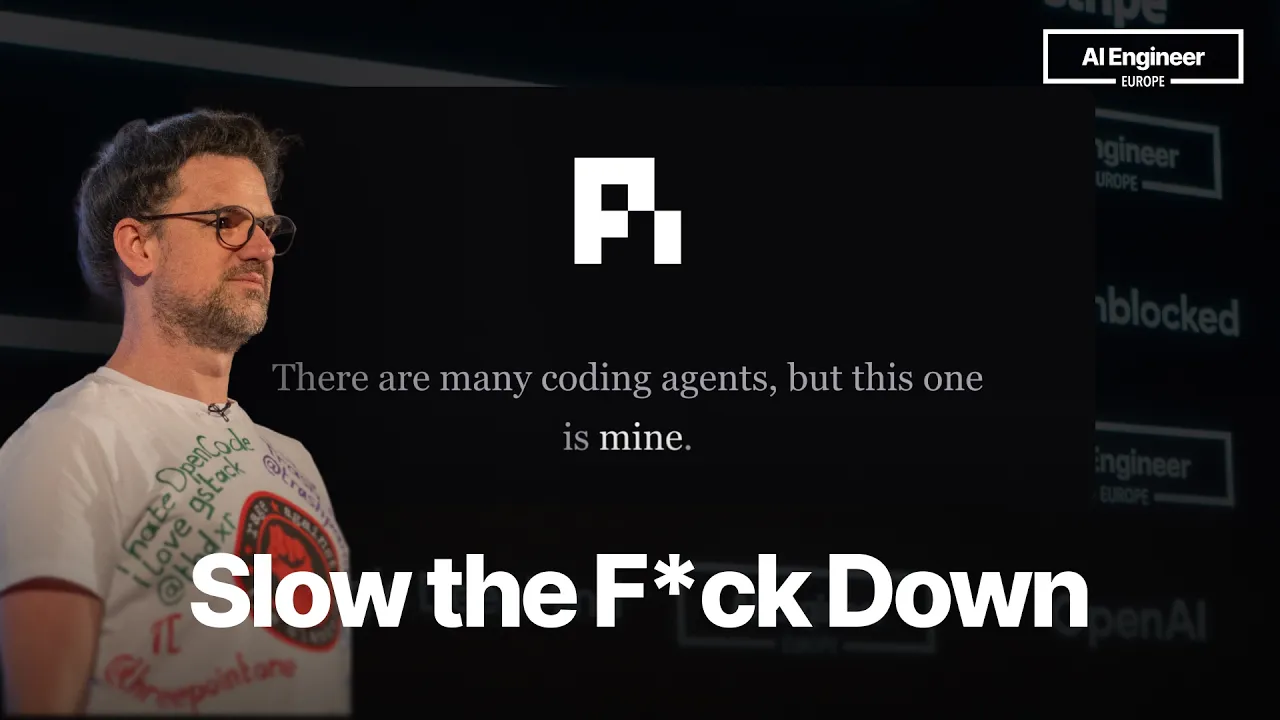
Mario Zechner explains why he abandoned Claude Code to build pi, a minimal self-modifying agent harness, and warns that unchecked agent use creates unreviable enterprise-grade complexity within weeks.
- Terminal Bench’s most minimal harness (only tmux keystrokes tool) outscores native model harnesses including Claude Code on the December 2025 leaderboard.
- Claude Code injects system reminders mid-context labeled ‘may or may not be relevant,’ which Zechner says confuses the model and breaks workflows.
- Open Code by default set CORS headers allowing any browser-opened website to access the local Open Code server.
- Pi ships with just 4 tools and a ~3-line system prompt; models don’t need 10,000 tokens to understand they’re a coding agent because post-training already covers it.
- OSS maintainers are being overwhelmed by AI-generated PRs; Zechner’s filter asks humans to write a short issue in their own voice — clankers never return to comply, making it a perfect bot detector.
- Agents compound errors with no bottleneck: humans cap daily mistake rate and feel pain that triggers refactors; agents happily keep shipping into broken codebases.
- A sufficiently detailed spec is just a program — any gap gets filled with patterns learned from the internet, which Zechner calls 90% garbage.
- Practical rule: scope tasks so the agent can find everything it needs; for critical code, read every line yourself — friction builds system understanding.
2026-04-16 · Watch on YouTube